Dress for Power & Grace: A Printable Checklist for Confident, Feminine Authority
Authority and femininity aren’t opposites—they’re a balance of structure, polish, and intentional softness. When you know which details signal “capable leader” and which details signal “approachable confidence,” getting dressed becomes a repeatable system instead of a daily debate. Below is a practical framework—silhouette, color, fabric, accessories, grooming, and presence—so your outfit matches the room you’re walking into and the woman you want to be in it.
Research also supports what many women already feel: what you wear can affect perception and performance. Harvard Business Review has noted that attire can influence how others evaluate competence and professionalism, and the APA highlights “enclothed cognition,” the idea that clothing can impact psychological processes like confidence and focus (HBR, APA).
What “Power & Grace” Looks Like in Real Life
Think of “power” as the signals that communicate clarity and capability, and “grace” as the signals that keep the look human, warm, and unmistakably feminine.
- Power signals: clean lines, tailored fit, intentional color contrast, quality fabric, and a decisive finishing touch (shoe, belt, blazer, or bag).
- Grace signals: thoughtful softness (drape, texture, refined detail), cohesive grooming, and approachable styling (not overly severe).
- The goal: be taken seriously at first glance while still feeling like yourself—confident, composed, and feminine.
Start With Structure: Silhouettes That Read as Authority
If you only change one thing, change the structure. A strong silhouette does the “leadership work” before you say a word.
- Choose one structured anchor per outfit: blazer, tailored trousers, a sheath dress, a structured knit top, or a crisp button-down.
- Keep proportions intentional: define the waist (belt, seam placement, tuck) or create a long vertical line (monochrome, long blazer, column dress).
- Aim for “close but comfortable” fit: pulling, gaping, or constant adjusting can undercut confidence.
- Hemlines and necklines: mid-thigh to midi and crew-to-v-neck (moderate) are reliable for professional authority without losing femininity.
Color and Contrast: Look Decisive Without Looking Harsh
Color is a leadership tool when it’s controlled. You don’t need loud to look strong—you need deliberate.
- Use a “core neutral” base: black, navy, charcoal, camel, or cream, then add one intentional accent (lip color, scarf, blouse, jewelry).
- Try controlled contrast: dark-light pairings (navy + ivory) read crisp and confident; too many competing colors can look unfocused.
- For softness near the face: swap pure black for navy, charcoal, chocolate, or deep olive; add a warm neutral to keep the look approachable.
- Let the occasion guide saturation: richer, deeper tones often feel more authoritative; softer tones can still look strong when the fit is sharp.
Fabric and Finish: The Quiet Signals People Notice
Fabric is where “expensive” and “intentional” live—even at an affordable price point. A great cut in a flimsy, wrinkled fabric loses its impact fast.
- Prioritize shape-holding fabrics: ponte knit, wool blends, structured cotton, denim with structure, satin (as an accent), and quality crepe.
- Avoid frequent wrinkling on high-stakes days: wrinkles can read “rushed” even when the outfit is beautiful.
- Balance matte and sheen: too much shine can feel overly trendy; too matte can look flat. Pair one polished piece with a soft texture.
- Small upgrades matter: steamed clothing, lint-free surfaces, clean shoes, and matching hardware (gold with gold, silver with silver).
Accessories That Say “In Charge” (Without Overpowering the Look)
Accessories should look like punctuation, not noise. The most authoritative styling usually has fewer pieces—chosen on purpose.
- Use one focal accessory: statement earrings, a structured bag, a belt with refined hardware, or a signature watch.
- Keep jewelry intentional: fewer pieces, higher cohesion. Mixed metals can work if it’s clearly deliberate and repeated.
- Shoes: closed-toe flats, loafers, block heels, or sleek boots signal authority; choose comfort that supports steady posture and pace.
- Nails and fragrance: neutral or classic shades keep attention on your message; fragrance should be close-range, not room-filling.
Outfit Formulas for Common “Authority” Moments
Quick Outfit Formulas: Power + Grace
| Situation |
Power Anchor |
Grace Element |
Finishing Touch |
| Interview |
Tailored blazer + straight-leg trousers |
Soft blouse or refined knit |
Structured tote + simple studs |
| Presentation |
Sheath dress or matching set |
Subtle drape or feminine neckline |
Pointed flat or block heel |
| Leadership meeting |
Monochrome column + long blazer |
Texture mix (knit + crepe) |
Watch + belt hardware match |
| Networking |
Structured jacket or vest |
Color accent (top, scarf, lip) |
Comfortable polished shoe |
The Printable Checklist: How to Use It in 5 Minutes
Download: Dress for Power & Grace (Printable Style Checklist)
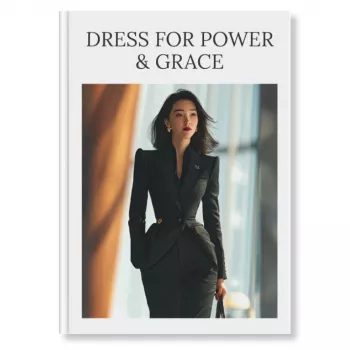
If you want a clear, repeatable tool you can keep by your closet or desk, the Dress for Power & Grace printable style checklist (digital download) is designed to make the process fast: choose your anchor, confirm your signals, and walk out the door feeling composed.
Pair it with the Goal-Setting Guide for Real Results (printable goal planner) when you want your wardrobe choices to support bigger milestones—interviews, leadership transitions, content days, or a season of stepping into more visibility.
FAQ
How can an outfit look authoritative without feeling too masculine?
Use one structured anchor (like a blazer, tailored trousers, or a sheath dress) and pair it with one softer element such as drape, texture, or a refined feminine detail. Cohesive grooming and an intentional color choice keep the look confident rather than severe.
What’s the fastest way to look more polished in the morning?
Check fit first, then quickly steam or smooth fabric, add one focal accessory, and finish with shoes and a bag that look intentional. Do a 10-second movement test so nothing shifts or distracts during the day.
What should be printed vs. saved on a phone?
Print the checklist for your closet or workspace so you can glance at it while getting dressed. Save the PDF or a photo on your phone for travel, last-minute changes, and quick outfit checks in different lighting.
Recommended for you









Leave a comment